Monitoring Environmental Radioactivity in the Vicinity of the Plomin Coal Power Plant

Institute for Medical Research and Occupational Health
IMI projekti

Foundation of the Croatian Academy of Sciences and Arts
Head: Sanja Stipičević
Duration: 2015-2016
SUMMARY
Triketone herbicides mesotrione and tembotrione and benzoylpyrazole herbicide topramezone represent the newest class of herbicides introduced to the market since 2000. Within a short time span, they have developed into the most popular herbicides used for weed control in corn. They are often also called allelopathic herbicides, because these compounds are synthesized on the model of leptospermone, chemical compound produced by some members of the myrtle family (Myrtaceae). Their unique chemistry offers excellent selectivity for corn, consistent and highly effective weed control, low active ingredient use rates (ten times lower compared to rates of frequently used triazine or chloroacetanilide herbicides), as well as low mobility due to relatively fast degradation in soil. Additionally, these herbicides are used for post-emergence application, which provides economical, biological and ecotoxicological adventages as opposed to pre-emergence herbicides. However, good water solubility (150-100 000 mg L-1) enhances their leaching potential through soil profile shortly after application. These herbicides are primarily used in corn, the most cultivated crop with a very strong weediness, suggesting a significant share of the total annual consumption of herbicides. At the same time, crop rotation after their application needs to be limited for two years. For convenient application and low environmental exposure it is necessary to know the mode the behavior of a new class of herbicides in their most commonly used type of soil and climate.

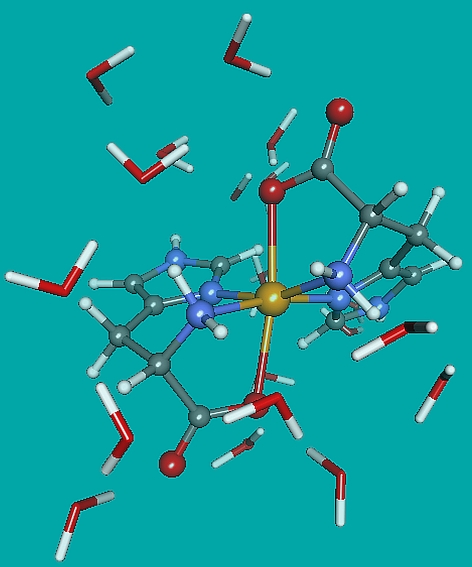
PROJECT ACRONYM: CopperAminoAcidates
Funded by the Croatian Science Foundation under Project No. IP-2014-09-3500
1 Sep 2015-28 Jan 2021
Bis(amino acidato)copper(II) complexes, Cu(aa)2, have been known since the second half of the 19th century but their intensive structural studies started in the 1960s and continue up to date. The studies have been motivated by (1) the finding that they are biologically important compounds as a part of the accessible physiological pool for transport and storage of the essential element copper, the fact that (2) they could be appropriate model compounds for copper-binding sites in metalloproteins, and the fact that (3) they are stereochemically interesting compounds. Bis(L-histidinato)copper(II), Cu(L-His)2, and the ternary bis-cooper(II) complexes with L-histidine and other L-amino acids (preferably L-glutamine, L-threonine, L-arginine, and some studies suggested L-cysteine) were determined as the predominant Cu(aa)2 in the blood. Stereochemically and stereoselectively, Cu(aa)2 are a very interesting class of compounds because of (1) various possible copper(II) coordination geometries, and (2) the ability of amino acids to bind to copper(II) either in a trans– or a cis-configuration. Trans and cis isomers for many Cu(aa)2 were identified to simultaneously exist in aqueous solutions by 14N superhyperfine structure in electron paramagnetic resonance spectra. The 13C and 2H fast magic-angle spinning solid-state NMR (ssNMR) spectra suggested that the isopropyl groups were static in trans-bis(L-valinato)copper(II) but could jump between different positions and adopt different conformations in the cis isomer, even at room temperature (Szalontai et al., Eur J Inorg Chem 2014: 3330). However, the cis-trans interconversion could occur in different solvent composition ratios, and the cis-trans isomerisation requires additional studies to be completely understood. Despite the extensive experimental physico-chemical characterisation studies of Cu(aa)2 in aqueous solutions attempted during the past 40 years, most studies gave information only on the first copper(II) coordination sphere (i.e., the number of nitrogen atoms attached to the copper(II) and their cis or trans position), and their exact structures in solution generally remain unresolved. On the contrary, complete structural information can be obtained by molecular modelling methods, such as quantum chemistry density functional theory (DFT), molecular mechanics (MM), and molecular dynamics (MD). Our recent DFT study of Cu(L-His)2 (Marković et al., Eur J Inorg Chem 2014: 198) is the first that clarified the structure of that physiologically important compound in aqueous solution at physiological conditions. Our computational results, obtained using the environment-free MM force field FFWa-SPCE (Sabolović et al., J Chem Theory Comput 2009, 5: 1940) for modelling of copper(II) complexes with aliphatic amino acids in vacuum, aqueous solution and solid state (by using the same set of potential energy functions and empirical parameters), were essential to understand the experimental results about the processes occurring at the molecular level in solution and influenced the isomerisation and crystallisation of specific isomers and/or conformers. The main goal of the project is to obtain new results on the physico-chemical properties (structure, energy, vibrations, cis–trans isomerism, conformational changes) in different surroundings (vacuum, aqueous solution, solid state) of the physiological Cu(aa)2 and selected copper(II) complexes with aliphatic amino acids because of their biological importance and stereochemical diversity by using the molecular modelling (DFT, MM, MD) and experimental (X-ray diffraction techniques, ssNMR) methods. We plan to develop a new environment-free MM force field for the physiological Cu(aa)2 by using the new DFT results and already published crystal structures as data set for the force field development. By combining these methods we expect to contribute to solving yet unresolved issues of the exact geometries in solution and solid state and of the processes occurring at molecular level. The new results will contribute to understanding the data required in the discovery of new potential drugs, since the detailed physico-chemical characterisation is a necessary first step in the drug development. It is worth mentioning that the interest in copper coordination complex research as antiproliferative agents has markedly increased in the last few years. We expect our results to have an impact on applications in bioinorganic chemistry, biophysics, biology, and medicine.
Jasmina Sabolović, PhD; Institute for Medical Research and Occupational Health (IMROH)
(jasmina.sabolovic@imi.hr)
Jelena Pejić (Budimčić); Institute for Medical Research and Occupational Health (IMROH)
(jbudimcic@imi.hr)
Marijana Marković (marijana.markovic@zg.t-com.hr) (until 1 Nov 2017)
Draginja Mrvoš-Sermek, University of Zagreb, Facutly of Science, Zagreb, Croatia
(mrvos@chem.pmf.hr) (until 12 Sep 2018)
Gábor Szalontai, University of Pannonia, Veszprém, Hungary
(Szalontai.Gabor@solidnmr.hu)
Michael Ramek, Graz University of Technology, Graz, Austria
(michael.ramek@tugraz.at)
Darko Vušak, University of Zagreb, Faculty of Science (dvusak@chem.pmf.hr) (from 24 Sep 2018)
SCIENTIFIC PAPERS
Invited lectures:
Oral presentations:
Posters: